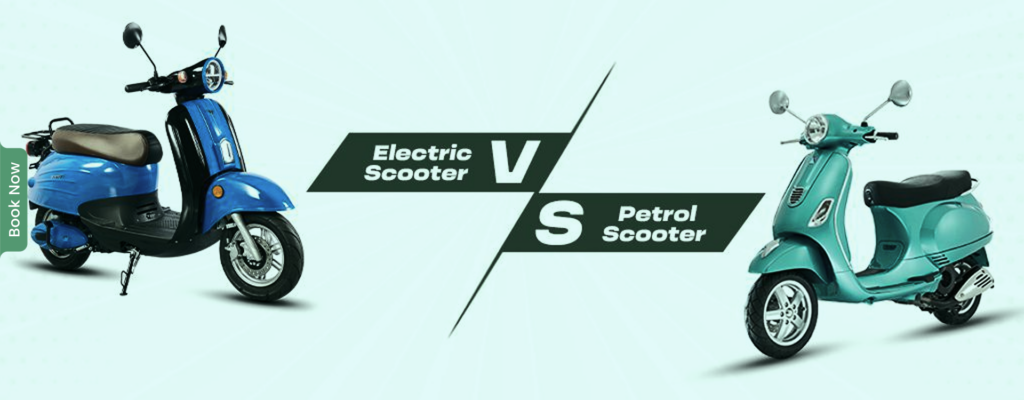
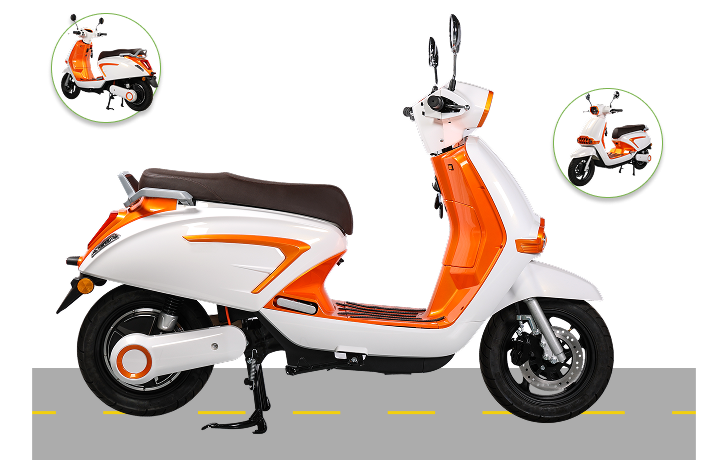
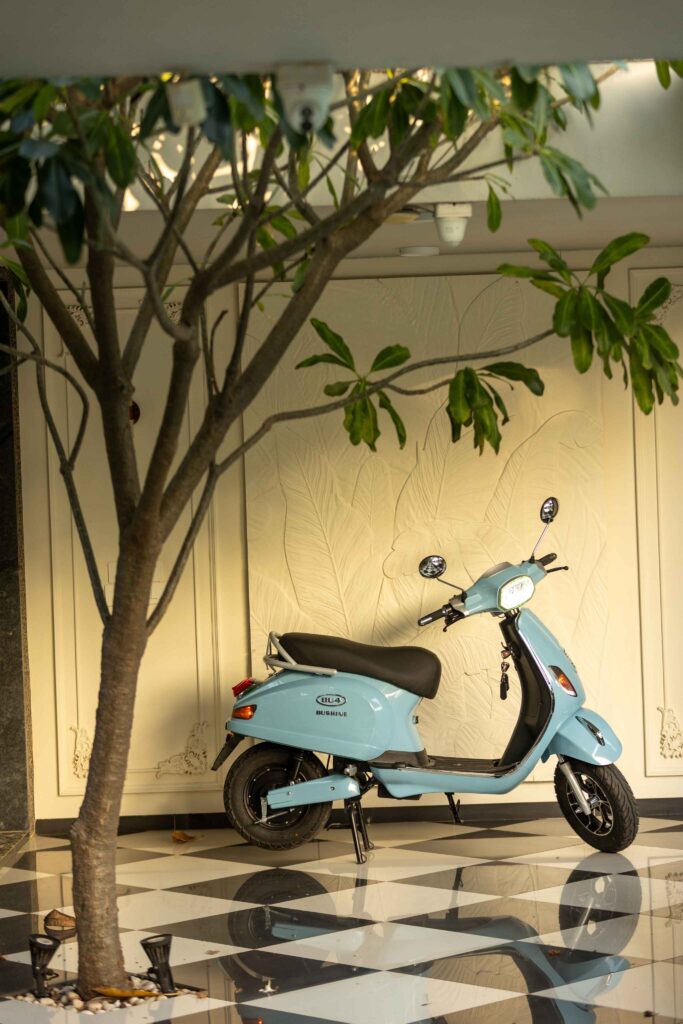


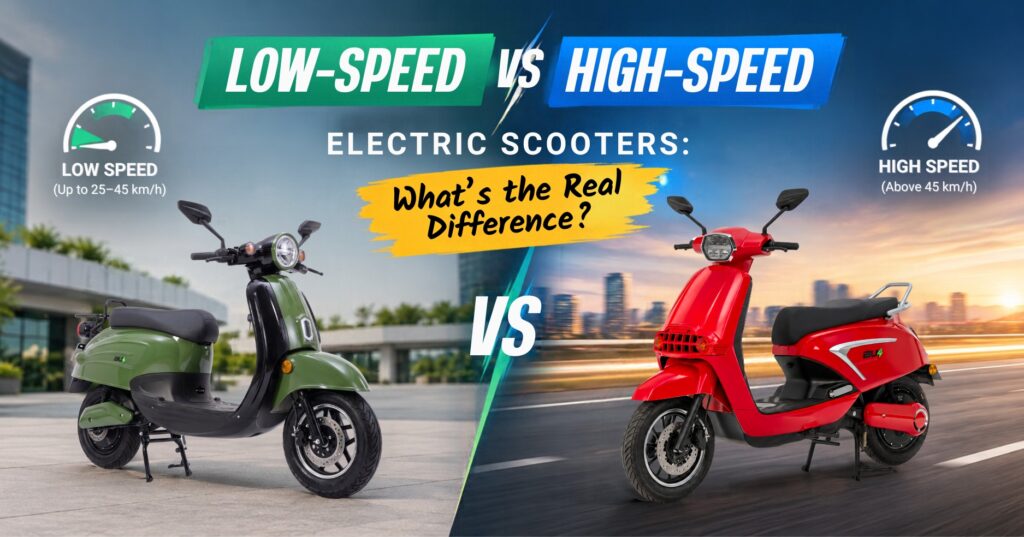
Electric scooters are no longer limited to a single type of buyer.
Today, you can find electric scooters designed for short neighbourhood trips, college commutes, everyday city travel, office commuting and longer-distance riding. But with so many options available, one question often comes up before buying:
Should you choose a low-speed or a high-speed electric scooter?
At first glance, the difference seems simple: one is slower and the other is faster.
But there is much more to it.
The speed category of an electric scooter can affect its regulatory requirements, registration, licence requirements, road usage, performance, riding experience and suitability for your daily commute.
That is why choosing between the two should not be based only on the advertised top speed.
The right approach is to understand how the categories work and then match the scooter to the roads you actually ride on.
What Is a Low-Speed Electric Scooter?
A low-speed electric scooter is generally designed for lower-speed urban mobility and short-distance travel.
In India, the regulatory treatment of certain electric two-wheelers is linked to technical conditions including their maximum design speed and motor power. Government road-safety material has described electric two-wheelers outside the motor-vehicle framework using a motor with 30-minute power below 0.25 kW and a maximum speed below 25 km/h, along with other prescribed conditions.
This is important because simply calling a scooter “low speed” does not automatically determine its legal status.
The certified specifications of the particular vehicle matter.
For buyers, this distinction is important because qualifying vehicles can have a simpler ownership experience than registered electric two-wheelers.
Typical characteristics of low-speed scooters
Depending on the model, a low-speed electric scooter may focus on:
- Lower maximum speed
- City and neighbourhood travel
- Short-distance commuting
- Simple operation
- Lower entry cost
- Easy everyday mobility
- Convenient charging
- Practical features for local travel
The exact specifications vary from one manufacturer and model to another.
What Is a High-Speed Electric Scooter?
A high-speed electric scooter is designed to operate at speeds above the low-speed threshold and is generally treated as a motor vehicle subject to applicable registration and road-use requirements.
For a registered electric two-wheeler, buyers typically need to consider:
- Vehicle registration
- Registration certificate
- Number plate
- Appropriate driving licence
- Insurance
- Applicable road and traffic rules
- Vehicle certification and compliance
Parivahan states that, as a general rule, a motor vehicle can be driven or allowed to be driven in a public place only after registration under Section 39 of the Motor Vehicles Act.
This is one of the biggest practical differences between the two categories.
Low-Speed vs High-Speed Electric Scooter: The Basic Difference
| Factor | Low-Speed Electric Scooter | High-Speed Electric Scooter |
|---|---|---|
| Primary purpose | Local and short-distance mobility | Broader city and longer-distance commuting |
| Speed | Designed around the applicable low-speed threshold | Above the applicable low-speed threshold |
| Registration | May not be required when the vehicle qualifies for the applicable exemption | Generally required |
| Driving licence | May not be required for a qualifying non-motor vehicle | Generally required |
| Number plate | Generally not applicable to qualifying non-motor vehicles | Required for registered vehicles |
| Road usage | Best suited to local/urban routes appropriate to the vehicle | More suitable for routes requiring higher speeds |
| Purchase cost | Often lower | Generally higher |
| Performance | Focus on controlled city mobility | Higher acceleration and cruising capability |
| Best suited for | Short local journeys | Longer and faster commutes |
Important: The legal requirements depend on the vehicle’s certified specifications and the applicable rules. Buyers should verify the exact model’s approval documents and current requirements rather than relying only on terms such as “low speed” or “non-RTO.”
Why Does 25 km/h Matter?
One of the most commonly searched numbers in the low-speed EV market is 25 km/h.
But there is an important distinction between:
“The scooter has a top speed of 25 km/h.”
and
“The scooter legally qualifies for the applicable low-speed exemption.”
The second statement depends on the vehicle meeting the relevant regulatory conditions, not just the number displayed in marketing material.
This is why buyers should check:
- Certified maximum design speed
- Motor power classification
- Type approval/certification
- Manufacturer documentation
- Applicable registration requirements
Government material from MoRTH specifically describes the technical conditions used for electric two-wheelers that fall outside the motor-vehicle framework.
So, before purchasing a “non-registration” or “no-licence” electric scooter, verify the actual certification and applicable rules for that particular model.
Registration: What Changes Between the Two?
Registration is one of the most noticeable differences for buyers.
For a vehicle that falls within the motor-vehicle framework, registration is required before it can be used in public places, subject to the applicable law and exemptions. Parivahan’s registration guidance explains the general registration requirement under Section 39 and the registration process.
A qualifying electric two-wheeler outside that framework does not follow the same registration requirement.
For the buyer, this can mean a significant difference in the ownership process.
A registered electric scooter generally involves:
- Registration application
- Registration certificate
- Number plate
- Applicable insurance
- Appropriate driving licence
- Applicable taxes/fees
- Compliance with road regulations
A qualifying non-motor vehicle may avoid the registration process
But this should always be confirmed for the exact vehicle.
Do not purchase a scooter based solely on a dealer saying “RTO nahi lagega.”
Ask for the manufacturer’s official documentation.
Do You Need a Driving License?
This is another area where buyers should be careful.
The Motor Vehicles Act regulates driving of motor vehicles and requires an effective driving licence for driving a motor vehicle in a public place. Therefore, whether a licence is required depends first on whether the particular vehicle falls within the motor-vehicle framework.
A qualifying vehicle that is outside that framework is treated differently.
For a registered high-speed electric scooter, an appropriate driving licence is required.
For a qualifying low-speed/non-motor vehicle, the licensing requirement can be different.
The key takeaway:
Don’t choose a scooter based only on the words “no licence required.”
Check the vehicle’s certified specifications and documentation.
How Does Road Usage Differ?
This is where the difference becomes very practical.
Imagine two riders.
Rider A: Local commuter
Their daily routine looks like:
Home → neighbourhood market → school/college → local shops → home
The rider rarely travels on fast-moving roads.
A low-speed electric scooter can be a practical choice for this type of mobility, provided its certified category and permitted use match the rider’s requirements.
Rider B: Long-distance commuter
Their route looks like:
Home → arterial road → major junctions → office → ring road → home
Here, traffic speed becomes an important factor.
A higher-speed registered electric scooter may be more appropriate because it is designed to operate within a higher-speed range.
Low-Speed Doesn’t Mean “Less Useful”
A common misconception is that a low-speed scooter is simply a cheaper version of a high-speed scooter.
That’s not necessarily true.
The two can be designed around different transportation needs.
For someone travelling 5–15 km around local roads every day, a 25 km/h-class vehicle can provide exactly the type of mobility they need.
They may not need:
- High top speed
- High-power motor
- Long-distance performance
- High-speed road capability
Instead, they may prioritise:
- Ease of use
- Lower running cost
- Comfortable riding
- Simple charging
- Practical storage
- Easy manoeuvrability
The key is to match the vehicle to the journey.
When Does a High-Speed Electric Scooter Make More Sense?
A high-speed electric scooter becomes relevant when your daily riding involves faster roads or longer distances.
Consider a commuter travelling 30–50 km every day.
Their requirements may include:
- Higher cruising speed
- Faster acceleration
- Better ability to integrate with city traffic
- Longer usable range
- Greater route flexibility
- Registered road-going capability
In such cases, the additional requirements associated with a registered electric scooter may be part of the overall ownership equation.
The question isn’t simply:
“Which scooter is faster?”
It is:
“What kind of roads and distances do I actually ride every day?”
Low-Speed vs High-Speed: What About Range?
Speed and range are often discussed together, but they are not the same thing.
A scooter’s real-world range can depend on:
- Battery capacity
- Motor efficiency
- Rider weight
- Passenger/load
- Riding speed
- Road conditions
- Traffic
- Tyre pressure
- Weather
- Riding mode
- Battery condition
- Acceleration patterns
For example, riding continuously at higher speeds generally demands more energy than slower urban riding.
Therefore, a high-speed scooter isn’t automatically a long-range scooter, and a low-speed scooter isn’t automatically a short-range scooter.
Always compare the battery capacity and claimed range of the specific model.
What About Charging?
Both categories can generally be charged using their specified chargers, but charging time depends on:
- Battery capacity
- Charger output
- Battery chemistry
- State of charge
- Ambient temperature
- Charging system
For buyers, the more important question is:
Can I conveniently charge my scooter according to my daily usage?
If your daily travel is 15 km, overnight home charging may be more than sufficient.
If you travel 50–70 km every day, battery capacity and charging time become much more important purchase factors.
Which One Is More Economical?
The answer depends on how you use the vehicle.
A low-speed scooter can have a lower initial ownership burden because qualifying vehicles may not require the same registration and licensing process as registered motor vehicles.
A high-speed electric scooter may cost more initially and involve additional ownership requirements, but it can provide greater speed and route flexibility.
Therefore, don’t compare only:
Purchase price
Compare:
Total cost + practical usefulness.
Your calculation should include:
- Purchase price
- Registration/fees, where applicable
- Insurance
- Electricity
- Maintenance
- Tyres
- Battery warranty
- Battery replacement considerations
- Financing cost, if applicable
Low-Speed vs High-Speed: Which Is Better for Students?
For students, the first question should not be:
“Which scooter has more features?”
Instead ask:
- How far is the college?
- What type of roads are used?
- Is the rider legally permitted to operate the vehicle?
- Does the vehicle require a licence?
- Is registration required?
- Is there a safe place to park and charge it?
For a short local commute, a qualifying low-speed scooter can be practical.
For a student travelling on faster roads and who meets the applicable licensing requirements, a registered high-speed scooter may be more suitable.
Which Is Better for Office Commuters?
Office commuters should calculate their total daily distance.
For example:
10–15 km/day
A low-speed scooter may be sufficient if the route is primarily local and compatible with the vehicle’s permitted use.
20–30 km/day
Consider the road types, traffic speed and charging availability.
30–50+ km/day
A high-speed electric scooter may become more relevant, especially if the route includes major roads where traffic moves significantly faster.
Again, distance alone should not determine the choice.
Road type + traffic + daily distance + charging availability should be considered together.
What About Senior Citizens and First-Time Riders?
For some riders, controlled speed can be an important part of their mobility requirements.
A low-speed scooter can provide a more relaxed riding experience for short local journeys, while a high-speed scooter may offer greater road flexibility for riders who are comfortable operating a registered vehicle.
Regardless of category, riders should follow applicable safety requirements and use appropriate protective equipment.
A Simple Way to Choose Your Electric Scooter
Before visiting a dealership, answer these five questions:
1. How many kilometres do I travel every day?
Calculate your actual daily distance.
2. What roads do I use?
Local streets?
City roads?
Main roads?
Ring roads?
3. What speed does the traffic normally move at?
This helps determine whether a low-speed vehicle is practical for your route.
4. Do I need a registered vehicle?
If yes, look at registered/high-speed models.
5. What is my charging routine?
Can you charge at home?
How often?
How long is your daily ride?
These five answers can eliminate a large number of unsuitable options.
Low-Speed vs High-Speed: The Decision Isn’t About Speed Alone
The biggest mistake an EV buyer can make is choosing an electric scooter based only on its top speed.
A better approach is to think about your actual mobility requirement.
A low-speed electric scooter can make sense when the priority is simple, local and short-distance transportation.
A high-speed electric scooter becomes more relevant when the rider needs higher speeds, longer commutes and broader road capability.
Neither category exists for exactly the same user.
The right choice is the one that fits your daily distance, road environment, charging routine and legal requirements.
Where Does BU4 Fit In?
BU4 Auto offers electric scooters across different use cases, including models positioned in the low-speed and high-speed categories.
This makes it particularly important for customers to understand the difference between the two categories before selecting a model.
Rather than choosing an electric scooter simply because it has a higher number on the speedometer, buyers should first understand what they actually need from their everyday ride.
For customers exploring BU4 electric scooters, the next step should be to check the specifications and regulatory classification of the specific model and then compare it with their daily route.
Explore the BU4 range and find the electric scooter that fits your everyday ride.
BU4 Auto — Be Bold, Be Electric.
FAQs
Is a low-speed electric scooter the same as a non-RTO scooter?
Not necessarily as a marketing label. Regulatory treatment depends on the vehicle’s certified technical specifications and applicable rules. Buyers should verify the manufacturer’s certification and documentation.
Is 25 km/h the main difference between low-speed and high-speed EVs?
It is an important regulatory threshold, but buyers should not look at speed alone. Motor power and other prescribed technical conditions can also matter.
Does a high-speed electric scooter require registration?
Generally, an electric scooter that falls within the motor-vehicle framework requires registration for public-road use. Parivahan states the general registration requirement under Section 39 of the Motor Vehicles Act.
Does a high-speed electric scooter require a driving licence?
Yes, an appropriate driving licence is required to drive a motor vehicle in a public place. The exact licence category depends on the vehicle.
Is a low-speed electric scooter good for daily commuting?
It can be suitable for short-distance local commuting where its certified speed and permitted use match the route. For faster roads or longer commutes, buyers should evaluate a registered high-speed model.
Which electric scooter should I choose?
Consider your daily distance, road type, traffic speed, charging availability, required speed, budget and the vehicle’s regulatory classification.